Amazon Image Editing & Product Infographic Design: The Complete Seller's Playbook

Every Amazon sale begins with an image. Before a shopper reads a single bullet point, before they notice your price, before they consider your reviews — they have already made a subconscious judgment based on your main image. Professional Amazon image editing is no longer optional for serious sellers; it is the single highest-leverage investment you can make in your entire listing strategy. Yet most sellers treat their Amazon listing images as an afterthought — uploading raw manufacturer photos, skipping product infographics, and ignoring the precise science of main image retouching for high click-through rate (CTR) optimization. That gap is your opportunity. Whether you are a private label brand building from scratch or an established seller looking to squeeze more conversion out of an existing ASIN, this guide covers everything from Amazon TOS compliant main image retouching services and white background photo standards to advanced A+ Content and EBC layout design for brands, product infographic design to increase conversion rates, Amazon listing image optimization for mobile shoppers, and high-converting Amazon hero images with realistic shadows — giving you the complete visual playbook for 2026.
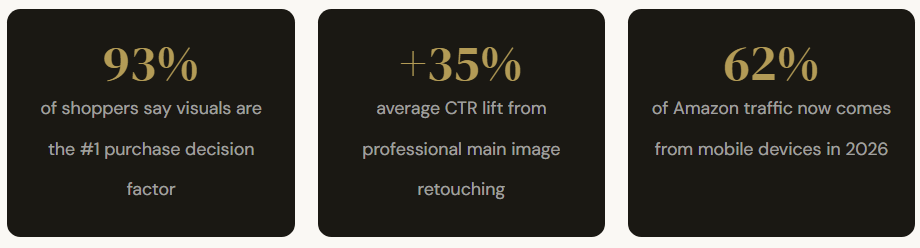
Why Amazon Listing Images Are Your Highest-ROI Asset
Amazon's A9 and A10 algorithms are heavily influenced by click-through rate. A listing that earns more clicks gets more impressions. More impressions generate more sales velocity. More velocity drives organic ranking. At every step of this loop, your Amazon SEO images — not your keywords — are doing the heavy lifting.
Think of your image stack as a silent sales team that works 24/7. The main image gets the click. The secondary images build desire. The infographics handle objections. The lifestyle shots create aspiration. The A+ Content closes the deal. Each image has a specific psychological job, and understanding those jobs is the foundation of effective photo manipulation for ecom.
"Your main image is a paid-traffic problem dressed up as a creative one. Every dollar you spend on Amazon PPC is amplified or wasted based entirely on whether your hero image earns the click."
The Main Image: Retouching for Maximum CTR
Amazon's Terms of Service are non-negotiable on the main image: pure white background photos (RGB 255, 255, 255), product filling at least 85% of the frame, no watermarks, no additional text, no props. Violating these rules risks suppression of your listing — meaning your ASIN disappears from search results entirely. This makes Amazon TOS compliant main image retouching a safety issue as much as an aesthetic one.
But compliance is only the floor. Within those constraints, elite hero image design is a competitive sport. The best performers in any category share a few traits:
Main image best practices (2026)
- Subject perfectly isolated on true white — no gray shadows bleeding into the background
- Realistic drop or contact shadow added in post to create depth and "groundedness"
- Correct color grading — colors match real product exactly to reduce returns
- Crisp edge masking, especially for hair, fur, fabric, and translucent materials
- Product scaled for mobile — dominant and legible at 160×160px thumbnail size
- Correct angle chosen (usually 3/4 view) to show maximum product shape and features
- Forproduct packaging retouch: label text is sharp and readable, foil effects preserved
The concept of a high-converting Amazon hero image with realistic shadows deserves special attention in 2026. As mobile screens dominate, a flat product on a flat white background looks weightless and cheap. A subtle, correctly lit shadow anchors the product, signals premium quality, and dramatically increases perceived value — without violating any TOS rules.
Product Infographic Design That Converts
Once the main image earns the click, your secondary image stack takes over. Product infographic design to increase conversion rates is the art of communicating product benefits, features, dimensions, and instructions in a visual format that a distracted mobile shopper can absorb in under three seconds.
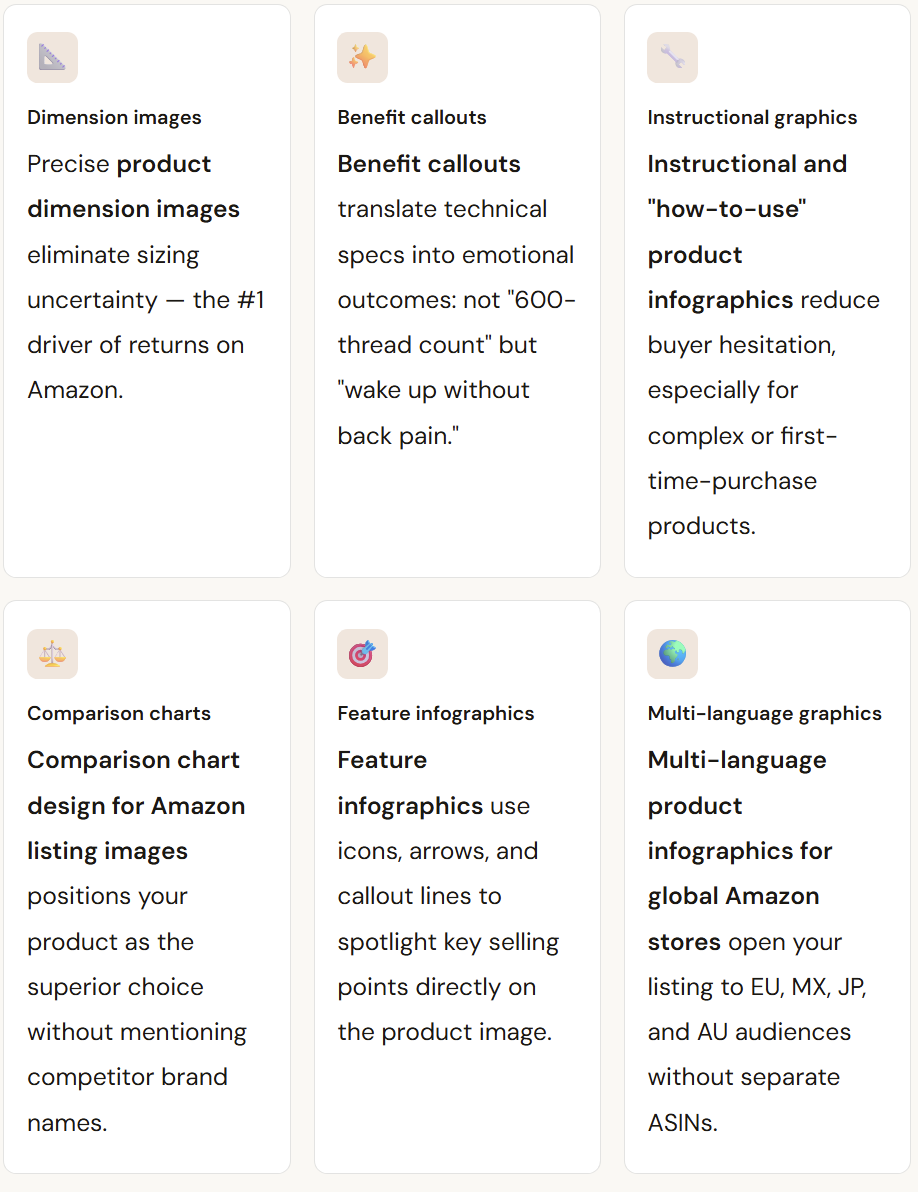
Before and after results infographics
Before and after results infographics for beauty products are the single highest-converting image type in the health, beauty, and personal care categories. Amazon's guidelines require that any transformation shown be achievable by a typical user of the product — exaggerated claims can trigger compliance issues. Done correctly, however, a credible before/after graphic can lift conversion rates by 20–40% in competitive categories like skincare, hair care, and supplements.
Material and texture callouts for apparel
Material and texture callout graphics for apparel solve a unique problem in clothing categories: online shoppers cannot feel the fabric. A zoomed macro shot of the weave, combined with callout text identifying the material composition and thread count, substitutes for that tactile experience and dramatically reduces the uncertainty that leads to cart abandonment.
Lifestyle Product Shots and Professional Composites
Lifestyle product shots serve a different psychological function than infographics. They don't inform — they inspire. They answer the question: "Can I picture myself using this?" The most powerful lifestyle images place the product in an aspirational but relatable context that matches the buyer persona exactly.
For sellers who cannot afford studio shoots for every ASIN, professional lifestyle composites for Amazon products offer a cost-effective alternative. A skilled retoucher can place a product into a licensed background environment with correct perspective matching, ambient light blending, and realistic shadow casting — producing results indistinguishable from a $5,000 location shoot at a fraction of the cost.
Explainer graphics for complex electronic products bridge the gap between lifestyle and infographic. A smart home device, for example, benefits from a lifestyle image showing it installed in a beautiful living room, overlaid with subtle callout lines pointing to the features visible in the scene.
A+ Content and EBC Design: Your Brand's Conversion Engine
If you are enrolled in Amazon Brand Registry, you have access to the most powerful conversion tool on the platform: Amazon A+ Content design (formerly called Enhanced Brand Content, or EBC). Amazon A+ Content and EBC layout design for brands replaces the standard product description with a rich, scrollable content section featuring custom imagery, comparison modules, brand story sections, and feature highlight layouts.
Amazon's own data suggests that well-executed A+ Content increases conversion rates by 3–10% on average, with high-quality implementations regularly delivering 15–20% lifts in competitive categories. That is free money for any brand that has invested in Amazon Brand Registry images and is eligible for the feature.
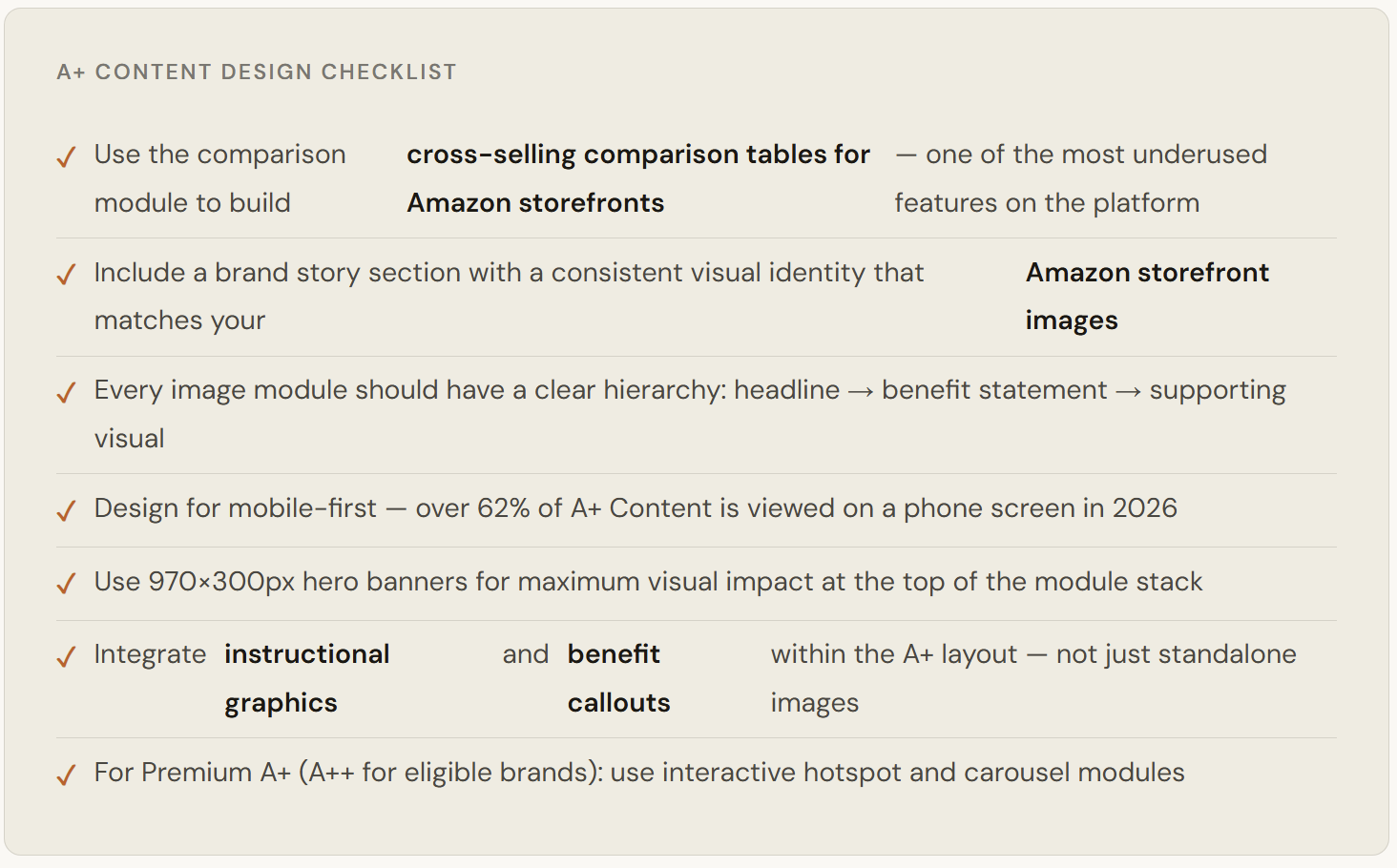
Amazon storefront design
Your Amazon storefront images are the homepage of your brand on Amazon. Unlike standard listing pages, your storefront is entirely under your creative control — no ads from competitors, no distracting widgets. A well-designed storefront acts as a destination brand experience, supporting higher average order values through product bundling, collection-based navigation, and brand storytelling. Amazon listing design for private label sellers who invest in a cohesive storefront consistently report 25–40% higher repeat purchase rates compared to sellers with no storefront.
Mobile Optimization: The 2026 Imperative
Amazon listing image optimization for mobile shoppers has moved from "nice to have" to mission-critical. In 2026, more than 62% of Amazon browsing happens on mobile devices. The entire design logic of your image stack must account for this reality.
On a mobile screen, your main image thumbnail is approximately 160×160 pixels. Any text, icons, or fine detail below 18pt is invisible. Your product must dominate the frame. Your color story must be bold enough to differentiate from adjacent listings in a grid view. Your hero image design must win the click not just on a 27-inch monitor, but on a cracked iPhone screen viewed in bright sunlight.
Technical Standards Every Editor Must Know
Professional Amazon image editing is not just about aesthetics — it is about technical precision that keeps listings compliant and performing.
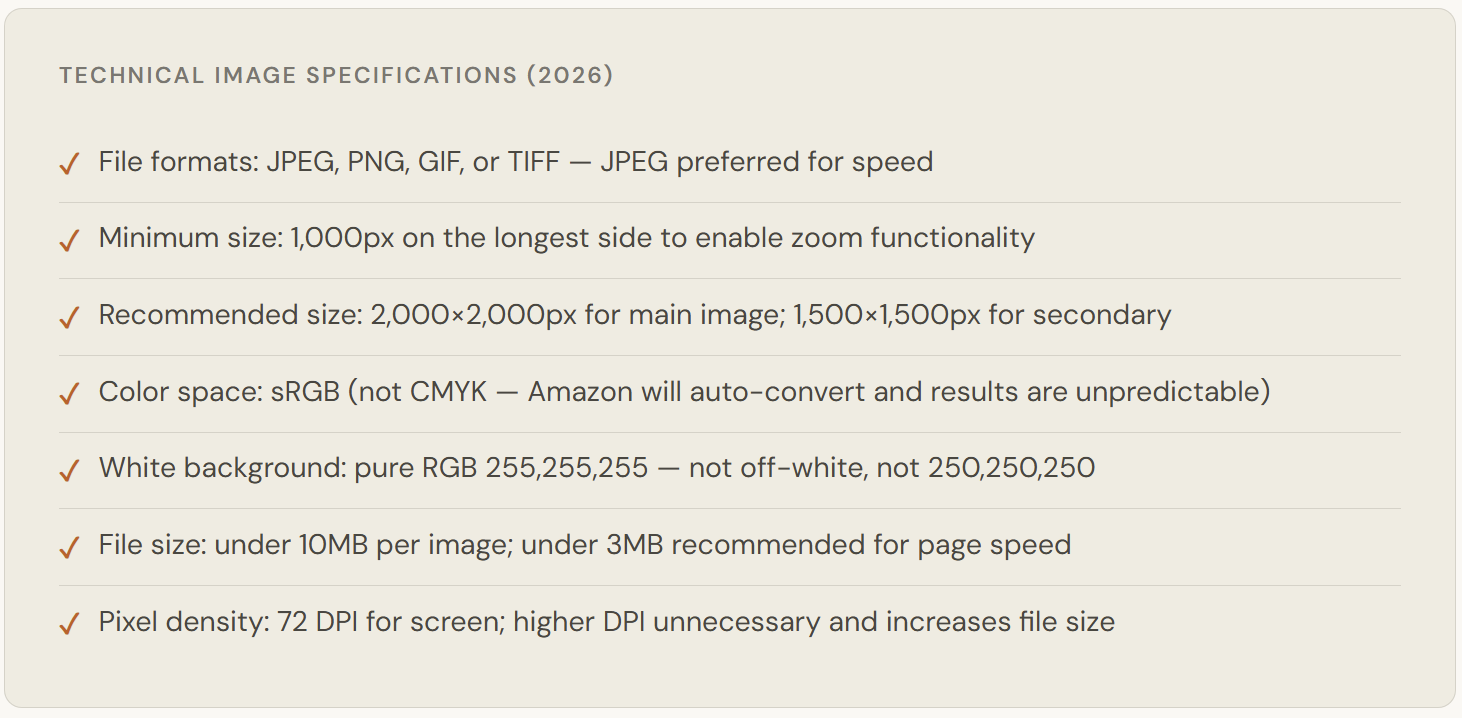
Topics Covered in This Guide
This article addresses the following search topics relevant to Amazon visual strategy:
Where to Start: A Prioritized Action Plan
If you are overwhelmed by the scope of Amazon visual optimization, start with the highest-leverage interventions first:
Week 1: Audit your main image against Amazon TOS. Get professional main image retouching with a proper white background and realistic shadow. Test CTR lift with a two-week Manage Your Experiments split test if eligible.
Week 2–3: Build out your secondary image stack. Prioritize: one product dimension image, one benefit callout graphic, one feature infographic, and one lifestyle composite. These four images alone represent the majority of secondary-image conversion impact.
Week 4: Design and publish A+ Content. Use the comparison module for cross-sell. Build a brand story section. Make sure every image in the A+ layout renders cleanly on mobile.
Ongoing: Build your Amazon storefront, expand to multi-language infographics for global stores, and refresh lifestyle imagery seasonally.
The brands winning on Amazon in 2026 are not the ones with the best products. They are the ones with the best images. Start there.
Ready to upgrade your Amazon image stack?
Get a free listing audit from our team of Amazon-specialist retouchers and infographic designers.
Request Your Free Audit →